

When damp or mould appears in a home, the standard response is often driven by panic and a search for a quick cure. Homeowners are routinely sold off-the-shelf mould sprays, chemical damp-proof courses (DPCs), or expensive mechanical ventilation systems.
However, damp and mould are not standalone problems; they are symptoms of wider environmental and/or structural failures. Effective treatment requires a holistic investigation by a qualified, independent building surveyor with no financial stake in selling chemical treatments or ventilation hardware.
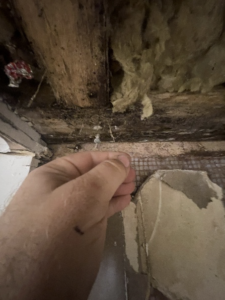
Wet rot to basement ceiling joists caused by penetrating water tracking along a concealed gas pipe in a concealed void.
The Hidden Risks: Beyond What Meets the Eye
Mould is a biological hazard, not an aesthetic defect. While visible black spots attract attention, a complete lack of visible mould does not mean there is no health risk. Mould colony structures often flourish in unventilated, hidden voids behind plasterboard, beneath floorboards, or within ceiling cavities where they can release spores and toxic compounds directly into indoor air pathways without ever showing on surface finishes.
When moisture persists, certain fungi produce airborne spores, mycotoxins, and bacterial endotoxins. Inhaling or coming into contact with these micro-pollutants can carry significant health risks, particularly for occupants predisposed to their effects:
- Pre-existing Respiratory Conditions: Individuals with asthma, chronic obstructive pulmonary disease (COPD), or allergic rhinitis experience severe symptom flare-ups.
- Immunocompromised Individuals: Those undergoing chemotherapy, taking immunosuppressant medications, or living with autoimmune conditions are far more vulnerable to fungal infections and systemic inflammatory responses.
- Infants and the Elderly: Developing lung tissue in children and declining immune function in older adults make these groups exceptionally susceptible to chronic exposure.
- Sensitised Occupants: Exposure to indoor mycotoxins can lead to Chronic Inflammatory Response Syndrome (CIRS), causing systemic fatigue, cognitive friction, and persistent joint pain.
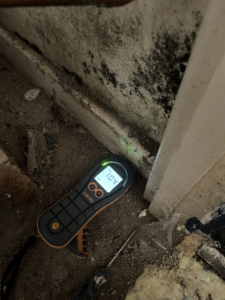
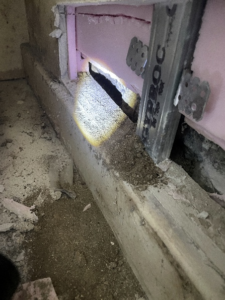
A poorly detailed steel stud wall with insulated plasterboard as found in a listed property in Ashford. A build-up of lime binder droppings was bridging the cavity next to a small concealed pipe leak.
Why “Silver Bullets”, Bleach, and PIV Systems Can Actually Make Things Worse
The market is flooded with surface treatments and gadget-based cures. These interventions frequently fail to address the root cause and frequently exacerbate the problem or cause structural harm:
- Bleach & Surface Mould Washes: Standard household bleach or surface sprays are primarily water-based. Bleach kills surface hyphae, but the chlorine evaporates quickly while excess water soaks deep into porous materials like plaster or timber. This feeds the deep-rooted fungal mycelium beneath the surface, prompting the mould to return faster and more aggressively.
- Positive Input Ventilation (PIV) Systems: PIV units push unheated or mildly heated air from the loft into the main living space to force moisture out through background trickle vents. If a home has uninsulated cold spots, draughty ceiling voids, or active dampness, this positive pressure forces warm, moisture-laden internal air directly into unheated wall cavities, sub-floor voids, and roof junctions. This can worsen condensation, accelerating timber rot and mould growth within concealed building elements.
- Chemical DPC Injections: Injecting silicones or fluid barriers into masonry is a classic “solution looking for a problem.” Rising damp is far less common than penetrating damp, bridged cavities, or high ground levels. Chemical DPCs do nothing to solve these issues and can trap moisture within historic brickwork, leading to freeze-thaw masonry failure.
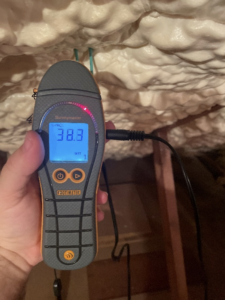
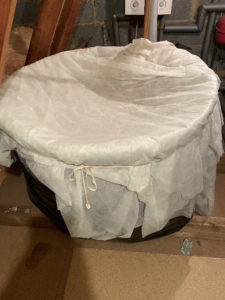
Raised moisture meter readings recorded to the underfelt of a north-facing roof pitch of a property in Ashford on a cold winter day. Such readings must be interpreted carefully and in the context of the wider environment.
The Limitations of Non-Invasive Tools
A widespread industry trend involves technicians walking through a property waving a basic electrical resistance meter or thermal imaging camera and handing over a summary report. Non-invasive tools have distinct limitations:
- Electrical Resistance Meters: These devices measure electrical conductivity, not actual water content. High readings often come from harmless surface salts, foil-backed insulation, or metallic wall ties rather than active dampness.
- Thermal Cameras: Thermal imaging measures surface temperature differences, which can indicate air draughts or insulation voids rather than moisture ingress.
- Misleading Psychrometric Data: Many commercial damp reports cite internal Relative Humidity (RH) and Absolute Humidity (AH) to diagnose “lifestyle condensation.” However, these reports routinely ignore external weather conditions. Internal RH is meaningless without measuring the outdoor temperature, outdoor humidity, and vapour pressure differential. If it is saturating rain outside, internal RH will naturally spike regardless of occupant behaviour.
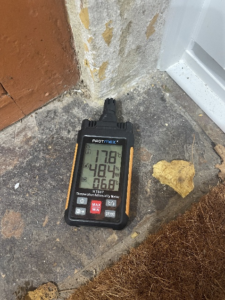
Efflorescence to the internal face of an external wall in a property near Wadhurst. Contributing factors included a replacement concrete floor with a damp-proof membrane in direct contact with a historic wall with no damp-proof course, the use of non-breathable materials, and raised external ground levels.
Real Physical Investigation & Building Pathology
Diagnosing moisture defects requires a physical investigation grounded in basic construction principles, including assessing high external ground levels, the adequacy and distribution of heating, drainage condition, the suitability/condition of building materials, and whether thermal insulation is missing, incorrectly installed, or causing cold bridges.
On-site investigations routinely demonstrate that high moisture readings stem from clear mechanical, thermal, and structural defects such as the following examples:
- High External Ground Levels & Bridged DPCs: Paved driveways, raised flower beds, or concrete patios built above the damp-proof course allow rainwater to bridge the barrier, soaking directly into lower internal walls.
- Inadequate Heating & Thermal Bridging: Inconsistent or insufficient space heating drops internal surface temperatures below the dew point. Where retrofitted insulation is missing or poorly detailed, thermal bridges form, creating localised condensation zones ideal for mould germination.
- Wet Rot from Concealed Service Pipes: High moisture levels in concealed areas where uninsulated or defective pipework is present.
- Cavity Bridging: Poor workmanship resulting in mortar bridging a cavity wall and creating a cold/damp spot and an ideal environment for mould growth.
- Cold Bridging at Uninsulated Wall Junctions: External cold bridging and localised condensation where an external wall directly abuts an external masonry wall without a damp-proof course (DPC) or thermal break.
- Inappropriate Concrete Slab & DPC Insertion: The insertion of an impermeable concrete slab floor and turned-up DPC against a solid internal wall sealed off natural ground evaporation.
- Failed Rainwater Goods: Gutters and downpipes overflowing or leaking onto walls for prolonged periods of time, resulting in saturation
- Failed Cement Repointing to Gable Walls: High internal moisture readings where rigid cement-based mortar has failed and allowed damp to penetrate a building.
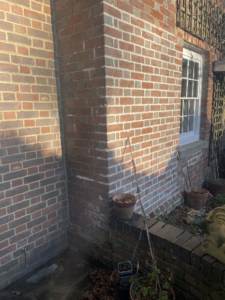
Internal dampness was caused in this property near Tunbridge Wells by cold bridging and a lack of a vertical damp-proof course, where a garden wall was built directly against an external wall.
The Holistic Approach
True remediation requires looking at the entire building envelope: evaluating roof drainage, lowering external ground levels where necessary, restoring breathability, ensuring adequate heating and insulation, checking that structural junctions are weathertight, and ensuring adequate, appropriate ventilation and moisture extraction.
Before committing to expensive ventilation installations or invasive chemical treatments, have an independent, qualified building surveyor with suitable experience evaluate your property. An expert who does not sell remedial products will provide an unbiased, physically verified diagnosis, protecting both your property’s structural integrity and occupants’ health.
Weald & City Surveyors Limited specialise in damp and mould investigations and offer a range of damp and mould inspections across Kent and East Sussex. Our specialist surveyors are both RICS- and Environment Study Centre-qualified/accredited.
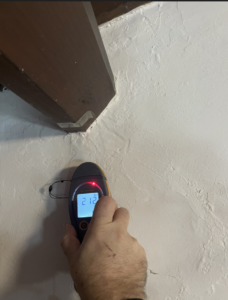
Penetrating damp to a gable wall in Tenterden that was caused by failed external cement-based mortar and reduced masonry thickness where a timber is built into the wall.